
Cultural Activities for Adults in Kauai That Most Visitors Don't Find
Key Takeaways
The best cultural activities for adults let you take part and learn about traditions, rather than just watch
On Kauai, at our luau, you can husk a coconut, make a lei, stamp a kapa-style design, or play kōnane, a strategy game once favored by Hawaiian royalty
Ask questions and treat each tradition as a culture that's still alive
At our oceanfront luau on Poipu Beach, you can try several activities in one evening, then stay for dinner and a Polynesian show
Check availability for our oceanfront luau
Most Kauai trips fill up fast with beaches, lookouts, and boat tours. Those are worth your time. But how much of Hawaiʻi will you understand when you fly home?
Cultural activities for adults help deepen your understanding (and appreciation) of where you’re visiting. They put the tools and the stories in your hands.
At Auli'i Lūʻau, our native Hawaiian-owned event shares these traditions every Monday and Wednesday on Poipu Beach. Here's what to look for and where to try it.
What Makes Cultural Activities for Adults Worth Your Time?
The best cultural activities for adults ask you to take part, then explain the meaning behind what you just did.
Hula is lovely to watch. But hold a pū'ili and hear how its split bamboo makes sound, and you'll remember it for years.
Look for experiences that join more than one thread, like food with history or music with story. A station that explains why kalo is important to Hawaii will teach you more about the food you enjoy while on island.
Before you book anything, ask yourself one question. Will you leave with something you didn't know before?
Hands-On Hawaiian Cultural Activities Adults Can Try in Kauai
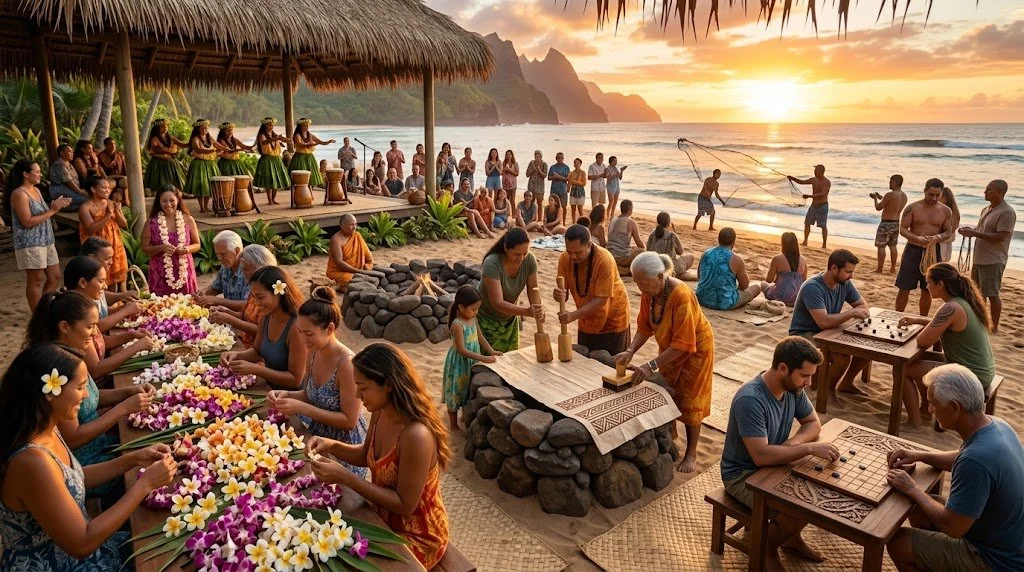
Our luau stations cover nine traditions, and each one ties back to how Native Hawaiians lived. You'll find the full list on our Hawaiian cultural activities page, but here's what each one teaches.
Food and Craft Traditions
Poi starts as kalo, or taro. You'll see cooked kalo pounded into a dense paste called pa'i 'ai on a papa ku'i 'ai, a wooden board, with a pōhaku ku'i 'ai, a stone pounder. It's slow, heavy work, and you'll learn how poi became Hawaiʻi's staple food.
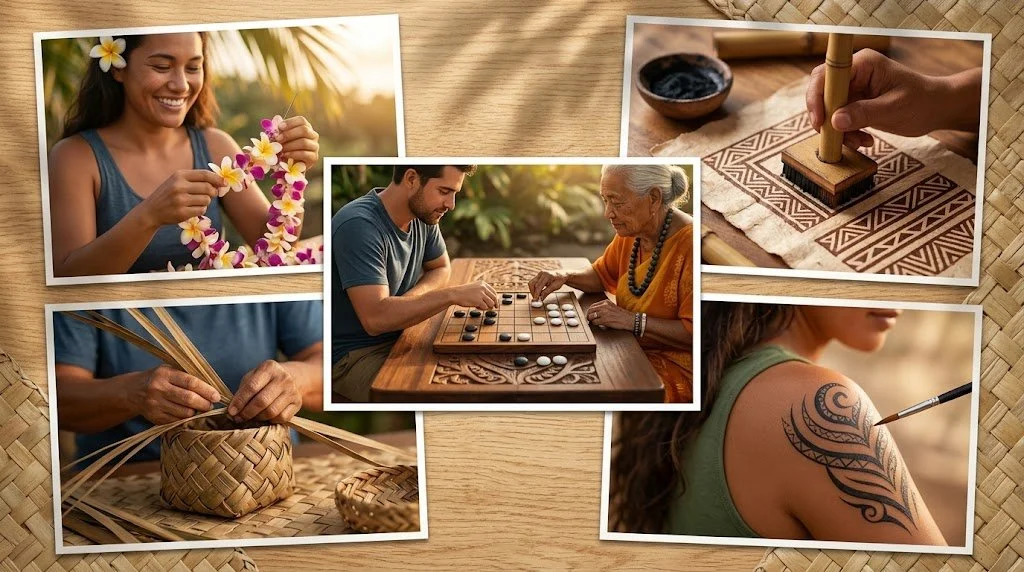
Coconut husking looks simple until you try it. With a wooden spike and your own hands, you strip away the fibrous husk. Your reward is fresh coconut water and soft white meat. Plenty of people who live in Hawaiʻi have never learned to do it the old way.
The coconut palm earned its name as the tree of life. It gave Hawaiians food, drinking water, roofs, and the materials for tools. At the weaving station, you'll turn its fronds into a basket or a headband.
A lei carries more meaning than most visitors realize. It can say love, respect, welcome, or farewell. You'll make your own to wear or to give to someone you care about.
Kāpala is the art of stamped design. In old Hawaiʻi, artisans decorated kapa cloth with carved bamboo tools called kālaipāpale, and the patterns told stories or marked identity. You'll pick your own shapes and colors with a modern version of those tools.
Games, Fishing, Hula, and Tattoo Traditions
Kōnane is often described as a mix of checkers and chess, played with black and white stones on a wooden board. Hawaiian royalty favored it. Sit down for a round and you'll see it's trickier than it looks.
Before fishing poles, Hawaiians relied on 'upena, handmade nets. Only skilled weavers earned the trust to make or cast them. You'll see how the nets came together and why they worked so well, and you might try a few loops and knots yourself.
Hula has a sound as well as a look. The 'uli'uli (feathered gourd), pū'ili (split bamboo), and ipu (drum) each bring their own rhythm. Once you've held them, you'll recognize them on stage later that night.
Kākau, or Hawaiian tattooing, goes back centuries. Designs marked genealogy, spiritual protection, achievement, and social rank, with ink made from kukui nut soot. You'll get a temporary airbrushed design and learn what the symbols meant.
How Can Adults Experience Hawaiian Culture Beyond Sightseeing?
Treat culture as something you take part in, and give it your full attention.
Put your phone away and try the station, even if you feel awkward. Nobody expects a perfect lei on the first attempt.
Ask about the story. Why this pattern? Who used this tool, and for what? The people who lead each station can tell you, and their answers often stick with you longer than the activity itself.
Look for places where food, music, dance, and history come together. Each one makes the others easier to understand.
Above all, remember that these traditions are alive. Native Hawaiians still pound poi and dance hula today. Come with curiosity and respect, and you'll get far more out of it.
Have more days on the island? Our guide to things to do in Poipu, Kauai covers beaches, hikes, and history close to Poipu.
Where Can You Try Multiple Hawaiian Cultural Activities in One Evening?
At Auli'i Lūʻau, Kauai's only oceanfront luau, you can try several cultural activities for adults before dinner, then watch the same stories come to life on stage.
Pre-Show Cultural Activities at Our Oceanfront Luau
We host the luau on Poipu Beach at the Sheraton Kauai Resort. Before dinner, you can move from station to station with a welcome cocktail in hand. Our Mai Tai features Koloa Rum, and the bar stays open all night.
You might weave a headband, then take on someone at kōnane. Many guests head to dinner with a lei around their neck that they made themselves.
Dinner and the Polynesian Show
A typical menu at our luau includes kalua pig, Kauaʻi fresh fish, lomi lomi salmon, Hanalei poi, and haupia. After the poi station, that scoop of poi on your plate means a lot more.
Then the show begins. Our director, Mi Nei Oliver-Martins, leads a journey from hula kahiko and keiki hula to the softer hula ʻauana. The Polynesian Revue follows the voyagers across Kahiki, Tahiti, Hawaiʻi, Aotearoa, and Samoa.
Watch for the hula implements you held earlier. They'll sound different now that you know what they are.
The night ends with the Siva Afi, a Samoan fire knife dance with roots in the Nifo oti, or war knife.
Ready to see Hawaiʻi from the inside? Check availability for our next oceanfront luau